Your figure for today
This is somebody else’s cast, opened from a shared link. Cast mine for today
What to do with it
Do
Don’t
Everything above is the day’s answer. Everything below is the rule it was read by, the original text, and the other sixty-three.
Which part of the book answers
Why it is not the whole figure
You do not read the whole figure. Which part of it answers depends on how many lines moved, and there is a settled rule for that, written down by Zhu Xi in the twelfth century.
The figure, line by line
About this translation
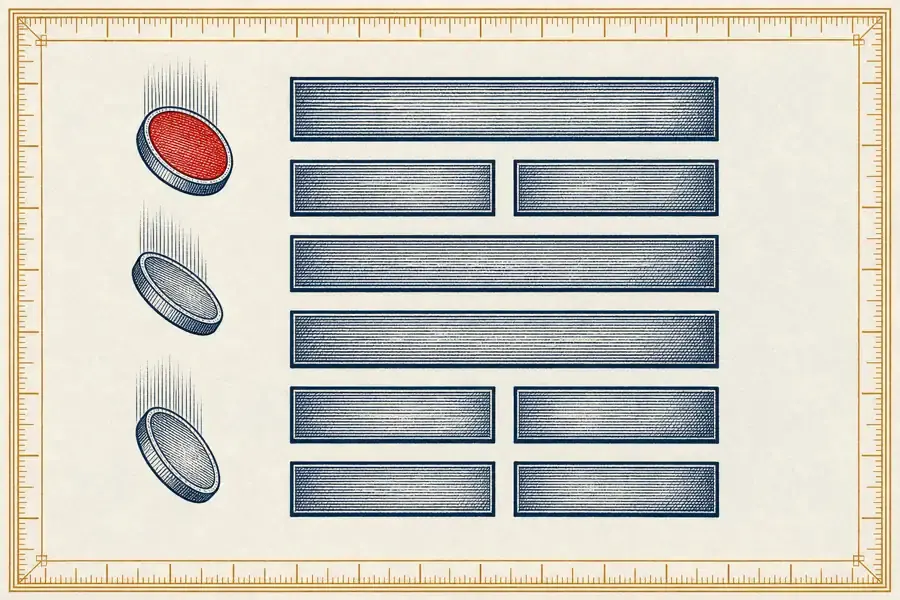
The judgment first, then the image, then all six lines bottom to top — the way they are cast and the way they are counted. The Chinese is the original text; the English underneath is ours, kept as close to the literal as it will go. Moving lines are marked in red.
Same day, cast the other way
Three coins takes a minute; fifty yarrow stalks, sorted by hand three times for every one of the six lines, takes an afternoon. They are not the same procedure sped up — the odds differ, so the same day cast both ways often lands on the same figure and then turns into a different second one. Your day is fixed either way; this only changes the hands it passed through.
Cast no. — · Three coins
How this figure is built
Three more figures fall out of this one
Every hexagram is two three-line figures stacked, and three more hexagrams fall out of it mechanically. Traditional readers look at all of them before saying anything. Each one below is a link — open it and you get its full text.
The two ways of casting do not agree
Why the short way is not the long way sped up
People usually assume the short way is just the long way sped up. It is not: the two produce different odds, and have done for as long as both have existed.
| Throw | The line | Three coins | Fifty stalks |
|---|---|---|---|
| 6 | Old yin — broken, and moving to solid | 1/8 12.5% | 1/16 6.25% |
| 7 | Young yang — solid, staying put | 3/8 37.5% | 5/16 31.25% |
| 8 | Young yin — broken, staying put | 3/8 37.5% | 7/16 43.75% |
| 9 | Old yang — solid, and moving to broken | 1/8 12.5% | 3/16 18.75% |
Look at what the two columns agree on. Both give a solid line exactly half the time. Both move an average of one and a half lines out of six. The whole difference sits in which line moves: with coins, solid and broken are equally likely to be the one that changes. With stalks, a solid line is three times more likely to move than a broken one.
Which means the same question, cast both ways, will often land on the same figure and then turn into a different second one.
Where the numbers in that table come from
The page does not read numbers off that table — it throws the three coins, or runs the stalk division, and the table is what that comes out to.
How often is “often”?
Where this number comes from
That last sentence is the honest version of what every book on the subject says, and it stops one word short. The table it sits under already contains everything needed to finish it, so here is the number — for the figure you have.
Where a cast can land
Keep going inwards
All sixty-four
The standard lookup table, and the reason every printed edition has one on the inside cover: find the lower three lines down the side, the upper three across the top, and the square where they meet is your figure. Tap any of them to read it without casting.
Where this text comes from
Seven notes on the text, the translation and the randomness
- The Chinese is the original, not a modern edition. The judgment, the image and all 384 line texts are taken from the 周易 pages at Chinese Wikisource. The book is pre-Qin — roughly three thousand years old — and has been out of copyright since before copyright existed.
- The English is ours, written for this page. That is a deliberate choice and it costs us something. The translation everybody quotes is Wilhelm–Baynes, published in 1950 and still under copyright, so it cannot go on a page like this no matter how many repositories have copied it. The Victorian alternatives are free but read like Victorian alternatives.
- So the English stays close to the literal and stops there. The text is short, concrete, and mostly about weather, animals, farming and war. Where it is plain we say it plainly: frost, a horse, a pit, a cup of wine. Where the commentators have argued for two thousand years about what a line means, we give you the line and not the argument.
- One sentence per figure is openly ours. Each hexagram has a short note saying what it is about, written for someone who has never opened this book. It is marked as ours because it is not in the original and we are not going to pretend otherwise.
- The randomness is your browser's. It comes from
crypto.getRandomValues, the same source used for cryptographic keys, and nothing about the cast is sent anywhere. The cast number seeds everything after it, so the same number always gives back the same six lines. - The stalk method is simulated, not faked. Fifty stalks, one set aside, the remaining forty-nine divided into two heaps, one stalk taken from the right heap, both heaps counted off in fours — three rounds of that per line, exactly as described. The odds in the table above are what falls out of the procedure. They hold as long as the heap is divided without bias, which is the same assumption every book on the subject quietly makes.
- What this is. The I Ching is a way of putting a question in front of yourself and getting something back that you did not choose. The figure does not know anything about you and this page does not either. It throws honestly, prints what it threw, and shows you the rule it used to decide which part of the book answers. The rest is yours.