Your cards for today
This is somebody else’s deal, opened from a shared link. Deal mine for today
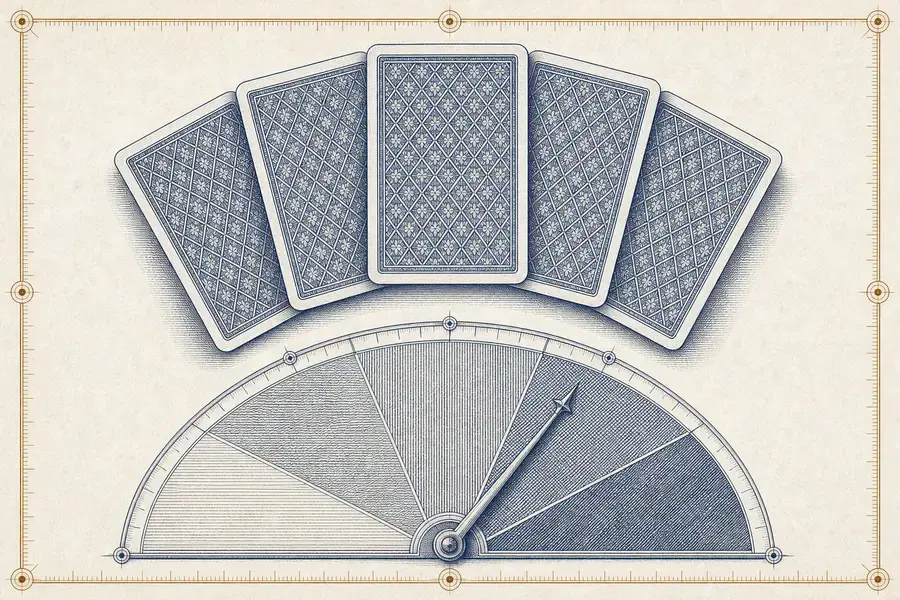
The day, in five
Do
Don’t
Where these five come from
Each of the five gets its own card out of the same shuffle — the eleventh through the fifteenth, which sit past even the ten-card spread, so widening the spread never moves them. Upright scores above fifty, reversed below it, and how far is set by the card’s number: an Ace barely shifts it, a King or a late Major swings it hard. Nothing on this page is rolled.
Ask it about one thing
This does not re-deal. The cards are fixed; choosing a subject only changes which part of them gets read back to you.
The same deal, further in
One card, three, or the full ten. It is the same shuffle every time, so your one card is the first of your three and the first of your ten. Going wider shows you more of the same deal — it does not hand you a different one.
Deal no. — · Three cards
Card by card
Why the position matters
Each position is printed with what that position is asking, because the same card means different things depending on where it lands. The other orientation is given underneath every card, quietly, so you can see what it just missed.
Everything above is the day’s reading. Everything below is how it was worked out, and the deck it came out of.
What this draw is made of
The shape of the whole deal
Before any single card gets read, a reader looks at the shape of the whole deal. All of that can simply be counted.
Bar length is the count over the number of cards dealt.
What the neighbours do to it
Where each element comes from
A card changes depending on what is lying next to it. The rule is four lines long and runs on the elements, so it can be worked out rather than felt.
Each card’s element is printed with where it comes from. The seven planetary trumps take theirs from classical astrology, not from the tarot order — leave those pairs out if you read strictly.
The numbers, read across
How the numbers are counted
The same number in four suits is one statement in four materials. Every five is its suit going wrong. So numbers get read across the deal, not card by card.
Majors one to ten count as that number. Eleven and up are reduced by adding their digits. The Fool is nought and sits outside the count.
What it adds up to
What counts toward the sum
Add every number on the table, then reduce until it fits inside the twenty-two. The trump it lands on is read as the distillate of the whole deal.
Court cards count as eleven to fourteen here. Another school drops them, which gives a different sum — this page shows the first.
How often this comes up
What the arithmetic assumes
Nothing traditional in this one. It is the same deal counted as arithmetic, so you can see which parts of it were unlikely and which were ordinary.
Worked from a full seventy-eight card deck, no card dealt twice, each card flipped on its own coin.
All 78 cards
Why the whole deck is here
The whole deck, upright and reversed, grouped the way it is built. Open a suit and it stays open — this is here so that looking up the card you just drew does not mean leaving the page.
How this deals
Twelve notes on the method
- The structure is Rider–Waite–Smith; the artwork is ours. Waite and Pamela Colman Smith published that deck in 1909 and it has long been out of copyright. Almost every modern deck descends from it, which is why a meaning looked up anywhere else will broadly agree with what is written here. The seventy-eight plates you see were drawn for this site in the engraving style the rest of these pages are set in — none of them is a scan of somebody else's cards.
- The whole deck is shuffled, then cards are taken off the top. Not drawn one at a time at random — drawn that way the same card could come up twice, and a deck with two Towers in it is not a deck.
- Upright or reversed is a separate flip per card, at even odds. Some readers never use reversals, some shuffle a fixed proportion in. Half and half, decided independently for each card, is the plain version.
- The randomness is your browser's, not a server's. It comes from
crypto.getRandomValues, the same source used for cryptographic keys. Nothing about the deal is sent anywhere. - The cut number reproduces the deal exactly. That one 32-bit number seeds everything that follows, so the same number always produces the same cards in the same order and the same orientations. Keep the link and the reading keeps existing.
- The card meanings here are written, not generated per reading. Every card has one upright paragraph and one reversed paragraph, the same ones every time, and both are printed whichever way the card falls. A reading that changes its own dictionary to suit the draw is not telling you anything.
- Elemental dignities come from the Golden Dawn, and only four rules long. Same element strengthens; Fire with Air and Water with Earth strengthen; Fire with Water and Air with Earth cancel; the other two pairings do nothing. The rule was written for the minors, which carry their suit's element. Applying it to the trumps is a choice, so every element on that list is printed with where it came from.
- Seven trumps have a planet instead of a sign, and planets have no element in the tarot order. The ones shown are the classical qualities — Mars and the Sun hot and dry, Saturn cold and dry, and so on. Mercury is left open on purpose: Ptolemy has it dry in one place and moist in another, and the traditional handling is that it takes on whatever it is next to.
- Numbers are read across the deal. A five is the suit going wrong in all four suits, so two fives in one deal is one thing happening twice, not two things. Trumps numbered one to ten join the count directly; eleven and up reduce by adding their digits, which is why The Tower shows up under seven.
- The quintessence is arithmetic, and the arithmetic is printed. Every number on the table is added and reduced until it fits inside the twenty-two; that trump is read as what the deal distils to. Whether court cards are counted is a school-level disagreement — they are counted here, and the sum is shown term by term so you can take them back out.
- The odds section contains no tradition at all. It is the same deal counted: how many orderings a seventy-eight card deck has, how often that many trumps turn up in a deal that size, how often that many land reversed. It is there so the unusual parts of a deal can be told apart from the ordinary ones.
- What this is. Tarot is a way of putting a question in front of yourself with something to push against. The cards do not know anything about you, and this page does not either — it deals honestly and writes down what it dealt. What the cards are for is the part you bring.